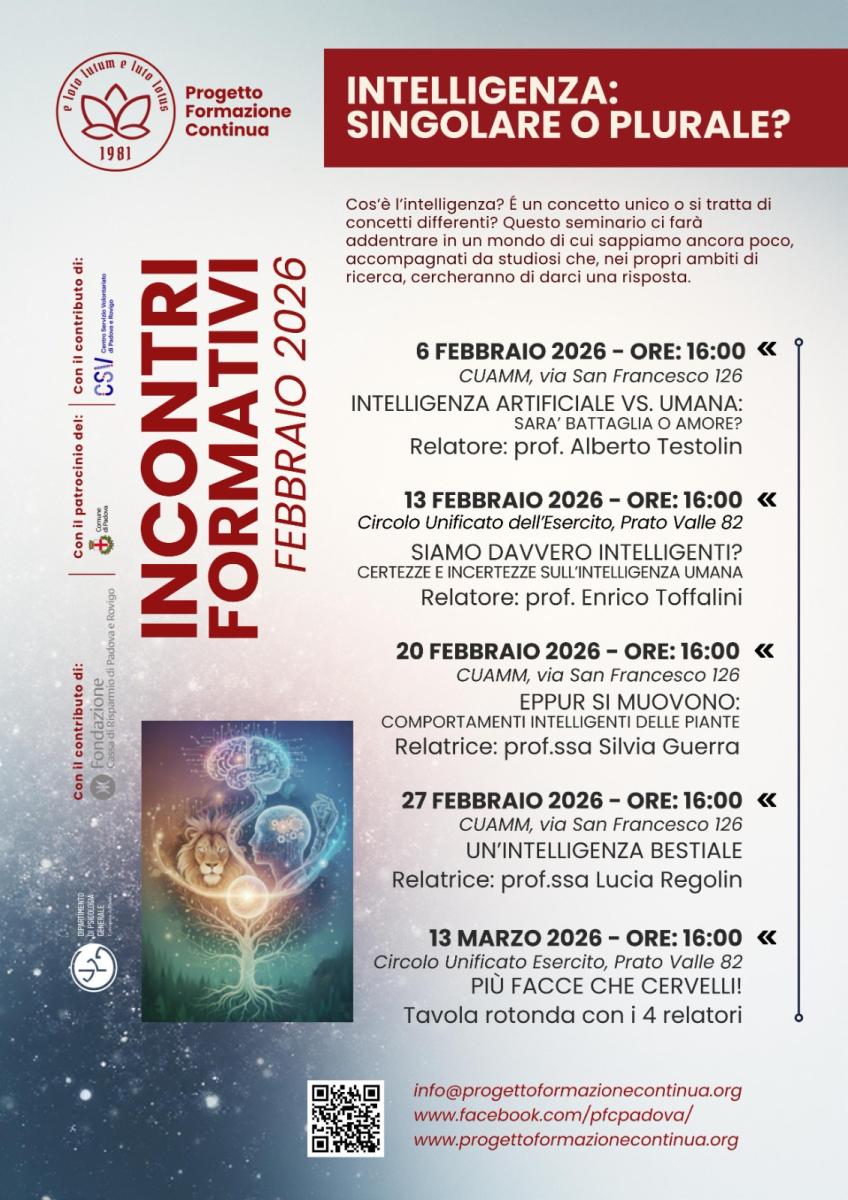
Intelligence: Singular or Plural?
Five meetings organized by Progetto Formazione Continua, exploring the definition - or definitions - of Intelligence. The meetings will be held in Italian.
MEETING I (February 6, 2026) – 4:00 PM
CUAMM, via San Francesco 126
ARTIFICIAL VS. HUMAN INTELLIGENCE: BATTLE OR LOVE?
We will retrace the main stages that led to the development of modern Artificial Intelligence (AI). We will explore how it is possible for a machine to learn from experience and reflect on the similarities and the (major) differences between AI and human intelligence. We will discuss the main critical issues surrounding AI and its potential implications.
With Alberto Testolin, graduate in Computer Science and PhD in Psychological Sciences, coordinator of the University of Padua’s Ethics Committee for AI.
MEETING II (February 13, 2026) – 4:00 PM
Circolo Unificato dell’Esercito, Prato Valle 82
ARE WE REALLY INTELLIGENT? CERTAINTIES AND UNCERTAINTIES ABOUT HUMAN INTELLIGENCE
Human intelligence was one of the first areas of in-depth scientific investigation in psychology. It is a construct that we are more capable of “measuring” than truly understanding. But what is IQ? Is there only one way to be intelligent? Does emotional intelligence exist? Can being too intelligent be a problem? Is it possible to increase one’s intelligence?
With Enrico Toffalini (Department of General Psychology - University of Padua. His research focuses especially on the neurodevelopment of cognitive abilities, intelligence, and individual differences.
MEETING III (February 20, 2026) – 4:00 PM
CUAMM, via San Francesco 126
AND YET THEY MOVE: INTELLIGENT BEHAVIOR IN PLANTS
At first glance, plants may seem like immobile organisms, incapable of actively interacting with their surrounding environment. This often leads to the assumption that they lack any form of intelligence. In reality, plants display numerous behaviors that can be defined as intelligent, such as adopting strategies to perceive their environment, interact with it, and adapt to it.
With Silvia Guerra, who earned her PhD studying plant movement, and is a researcher in the Mind(the)Plant research group at the Department of General Psychology (DPG), University of Padua.
MEETING IV (February 27, 2026) – 4:00 PM
CUAMM, via San Francesco 126
A BEASTLY INTELLIGENCE
Anthropocentric bias is a prejudice that leads us to recognize as intelligent only those behaviors similar to our own. However, expressions of intelligence may differ markedly even among closely related species, or conversely, show surprising similarities among phylogenetically distant species. Intelligence emerges as a plural biological phenomenon, raising fundamental questions about what it truly means to “be intelligent.”
With Lucia Regolin, Professor of Animal Psychology at the University of Padua. Her research focuses on animal and comparative psychology, with particular interest in early cognitive abilities in chicks (Gallus gallus).
MEETING V (March 13, 2026) – 4:00 PM
Circolo Unificato dell’Esercito, Prato Valle 82
MORE FACES THAN BRAINS!
Round table discussion with the four speakers, who will compare perspectives and debate convergences and divergences on this fascinating and complex topic.
The association Progetto Formazione Continua was founded in Padua in 1987 by Prof. Renzo Scortegagna, professor of Sociology at the University of Padua. The Association aims to offer adults and seniors opportunities to expand their knowledge across various fields of social life and to acquire critical tools useful for understanding everyday reality. Its main activity is the organization of short courses (5–6 meetings) on current topics with strong relevance to daily life, following an interdisciplinary approach.
The initiative is supported by the Fondazione Cassa di Risparmio di Padova e Rovigo, the Centro Servizi di Volontariato di Padova, and by the Department of General Psychology - University of Padua.