

“The three-door dilemma: even fish fail at probability puzzles”
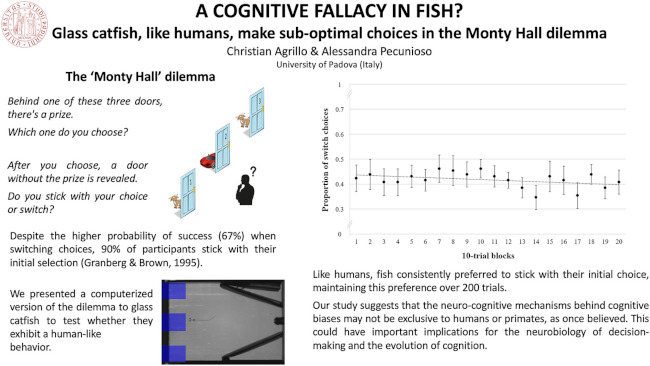
Humans often make reasoning errors when they have to make decisions under conditions of uncertainty. These “mental traps,” known as cognitive fallacies, often arise from incorrect assessments of the probability that a given event will occur or from irrational responses that accompany decision-making. One of the most famous examples is the Monty Hall dilemma, a probability game in which most people tend to choose the less advantageous option. Made famous by a television game show, the dilemma involves choosing among three doors, only one of which hides the prize. After the initial choice, the host opens an empty door and offers the contestant the chance to keep their original decision or switch. Even though the correct calculation shows that switching doors doubles the probability of winning, most people prefer not to switch, ignoring the fact that the host’s choice is not random and that the two remaining options do not have equal chances of leading to a win.
(for an online version, see: https://sites.unipa.it/sanfilippo/montyhall/ )
Studying reasoning fallacies in animals can help us understand what is “typically” human and the evolutionary origins of certain cognitive processes. So far, research on primates and birds has produced mixed results. Macaques appear to struggle with this statistical puzzle much like humans do, whereas pigeons seem to quickly learn to switch their initial choice and optimize their chances of success. This led researchers to believe that the cognitive processes underlying such reasoning fallacies were mainly linked to the complex neurocognitive systems of primates, both human and non-human.
Research conducted at the University of Padua by Christian Agrillo and Alessandra Pecunioso opens up new perspectives by testing specimens of ghost fish (Kryptopterus bicirrhis). When presented with a computerized version of the Monty Hall dilemma, the fish—like humans and macaques—tended to stick with their initial choice rather than switch to the second (and more advantageous) remaining option. The fish also continued to confirm their first choice even after 200 trials, despite the fact that the reward was obtained more frequently when they switched.
“Humans tested on this task make errors in probability calculations, but that is not the only factor,” explains Prof. Christian Agrillo. “It has been shown that people sometimes stick with their first choice out of fear that switching at the last moment might prove disadvantageous, thus perceiving a ‘loss’ compared to the situation in which they felt they had already secured the prize. There is also a kind of illusion of greater control over events at the moment of the first choice, when it is made without interference from the host. We cannot rule out that certain ‘emotional’ responses may also occur in animals, but we believe that a more plausible explanation here is the difficulty fish have in estimating conditional probabilities.”
“It is not the first time that animals phylogenetically distant from us have shown interesting convergences in perceptual and cognitive processes,” adds Dr. Alessandra Pecunioso. “The fact that a fish now makes a suboptimal choice in the Monty Hall game suggests that the cognitive processes underlying so-called reasoning fallacies can also occur with a neural circuitry organization completely different from our own, and may even be present in animals without a cerebral cortex.”
Article: https://www.sciencedirect.com/science/article/pii/S0010027726000041